
- Follow us


WSP Canada Inc. (WSP) was retained by the City of Toronto to undertake the preliminary and detailed design for the replacement of the Scarlett Road culvert over Humber Creek. The culvert is located under Scarlett Road in the City of Toronto, Ontario, approximately 0.72 km north of Eglinton Avenue West and 1.1 km south of Lawrence Avenue West. Scarlett Road is considered to have a north-south alignment, and the culvert to have a west-east alignment.
RELATED: Precast Solutions Provided to the “Imagine Jasper Avenue” Project in the City of Edmonton
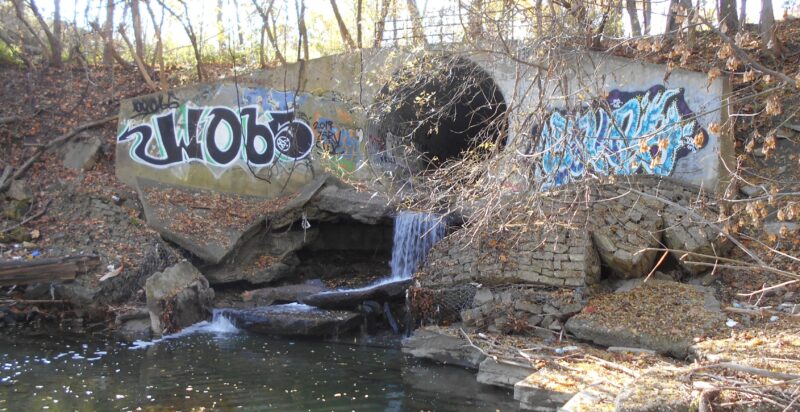
The 1960’s existing Scarlett Road over Humber Creek structure is a 61.2 m long 4.3 m diameter galvanized circular Structural Plate Corrugated Steel Pipe (SPCSP) culvert with a 0.15 m thick concrete liner along the entire length of the culvert. The 2015 Ontario Structure Inspection Manual (OSIM) inspection report, provided by the City of Toronto, showed the existing culvert to be in good condition with a Bridge Condition Index (BCI) of 69.94. A preliminary condition survey, performed by WSP Canada Inc. in 2017 and 2019, showed the existing structure to have medium to severe corrosion in the steel barrel with several perforations, severe cracks and deterioration of the concrete liner, permanent SPCSP deformation at the north side of the barrel, and severe spalls and delamination on the wingwalls, inlet, and outlet components. On the east side of the culvert, a concrete end treatment and several gabion baskets had collapsed into the creek, causing it to scour. On the west side, severe sediment increased the elevation of the creek past the inlet of the culvert. There is no record of any rehabilitation work for this structure. Picture 1 shows the collapsed concrete end treatment and gabion gaskets into Humber Creek.
The City of Toronto prefers to replace current corrugated steel pipe (CSP) structures based on previous experience with lower durability of either relining or replacement of CSP structures with new CSP pipes or plates. The city’s preference for precast concrete and its higher durability was the main factor in the decision between the rehabilitation or replacement of this CSP structure.
The preliminary design considered investigations of existing culverts, identification of suitable replacements, detailed design, permit approvals, construction administration, and post-construction
services. The key issues of this assignment were the following:
• Adequate hydraulic and structural evaluations
• Addressing concerns from adjacent property owners, Toronto Forestry and Ravines, and the Toronto and Region Conservation Authority (TRCA)
• Detailed field investigations
• Life cycle costs for structure replacement; and
• Utility coordination at all phases of design and construction.
The replacement of the existing structure created an opportunity to improve the hydraulic performance of the culvert. The city of Toronto’s two criterium are as follows:
• Proposed culvert shall provide a freeboard of 0.3 m or greater under the 100-year storm event. A “freeboard” is defined as the clearance provided between the water surface elevation and the road low point elevation; and
• Proposed culvert shall not increase water levels, upstream or downstream, under all storm even as compared to existing conditions.
Hydraulic analyses were performed by WSP to determine the existing hydraulic conditions of the
structure. A HEC RAS hydraulic model was obtained by the TRCA. The significant findings are as follows:
• The 100-year water surface elevation for the existing SPCSP culvert is 118.940 m
• The upstream elevation and downstream elevation are 111.597 m and 110.002 m, respectively. The top of road elevation in the vicinity of the culvert is at 120.454 m
• The existing structure does satisfy the freeboard under the 100-year storm event and does satisfy the City of Toronto’s freeboard criterion.
Through hydraulic analyses, a hydraulic opening of 8.535 m span x 3.350 m rise was found to satisfy these criteria.
The following two structures were considered for the replacement of the existing culvert:
• Precast concrete rigid frame box culvert
• Precast concrete rigid open-footing culvert on cast-in-place concrete footings.
Precast concrete units are recommended, in lieu of cast-in-place structures, for the following reasons:
• Precast concrete will reduce the in-field construction duration and impact on traffic as there is no need to erect/remove formwork and there is no concrete curing time; and
• Precast concrete construction offers a higher quality product than cast-in-place concrete due to improved quality control under “factory” conditions.
Precast box culvert structures are advantageous as they provide an invert that does not erode, thus eliminating future scour concerns. Precast boxes also eliminate the need to construct footings, thereby reducing the overall construction duration. However, a flume pipe was required within the existing culvert to convey flows during construction; this precluded the installation of precast box units.
Therefore, an open-footing structure was selected at this site to span over the temporary flow passage
system.
An 8.534 x 3.350 m CON/SPAN precast open footing structure, manufactured by CON CAST PIPE, was utilized for the replacement of this structure. Coupler connections and hook inserts were pre-installed at the edge of the top slab for each precast concrete unit to connect to adjacent units via a steel plate to facilitate shear force distribution throughout the entirety of the culvert.
The erection of precast concrete units was performed by a Liebherr LTM 1400-7.1 – 500 ton AT crane. Each 26,536 kg precast concrete unit was off-loaded by its lateral handling anchors and rotated to its final installation position. Holding chains were then connected to the top four (4) installation anchors and lifted into their final position on top of precast open footings. Stage 1 approximately half the length of the culvert, comprised of a total of (19) precast concrete units. Overall, 38 precast units were placed for a total culvert length of 61.4 metres.
TRCA concerns focused mainly on the erosion of creek and habitat preservation. An adjacent City of Toronto project restored Humber Creek upstream of the culvert, ensuring a seamless transition of both in-stream works, and improvement of fish passage and flow conditions through the culvert. WSP implemented several erosion controls and fish passage solutions such as fish ladders and rock filled protected slopes. As per TRCA’s request, armour stone retaining walls were constructed at the inlet and
outlet of the culvert. Picture 2 shows the partially completed outlet with armour stone and fish ladder.
By replacing the existing SPCSP structure with a precast concrete rigid open footing culvert on precast concrete footings, the City of Toronto’s criterium on durability, hydraulic and structural improvements were met, along with TRCA’s requirements for improvements in flow conditions and fish passage.
Luis Ayala; EIT
WSP Canada Inc.
Precast Producer: CON CAST PIPE
No one likes a drippy faucet at home, so why should a drippy pipe underground ...
A new development in Barrhaven, Ontario (just south of Ottawa) needed a bridge structure to ...

A 1 million square foot Amazon warehouse distribution centre located in Ajax, Ontario, just west ...
