
- Follow us


During the design process, selecting the appropriate material is always challenging, especially when multiple constraints are attached to the project. Professional engineers constantly deal with various issues that require in-depth knowledge of the engineering field related to the project.
Stormwater Detention -Nose Creek, Calgary
Management skills become more important nowadays as the project goes through the following five phases:
Every project should be analyzed according to the demands and, more importantly, the constraints. In the stormwater management world, as municipalities continue to grow and expand, engineers are responsible for ensuring that a mechanism is in place to mitigate the excessive runoff that could potentially make its way into the sanitary sewer system, which will ultimately increase the inflow\infiltration ratio. This could result in overloading the pipe network in terms of its capacity that was originally designed. Each site needs a system allowing the stormwater to be retained and slowly delivered to the existing city’s pipes. Overland surface areas can be a great solution to maintain this volume of water using parking lots (for small areas) or retention ponds for larger areas such as subdivisions.
RELATED: Toronto basement flooding protection project
However, the retention of surface areas is limited to different design elements. In multiple situations, these surface areas are more valuable since they can be used for more construction to generate more revenue for the developer rather than using these large areas for retention systems. So, what should we do instead? If we have this problem, is there a way that we can use to control the runoff from hard surfaces, roofs, and green areas? Well, thankfully, for any complex problem, there is a solution in life except for two things, according to wise folks: taxes and death itself; these two cannot be avoided. A little bit too extreme, but it is a true statement.
Part of the solution would be installing a retention system that will go under the ground; this could simplify the issue of ponding on the surface and mitigate the problem of having massive areas to store water, such as retention ponds. As an engineer, we come up with very sophisticated solutions for issues; somehow, we foresee problems that are not present. Are we, in some way, fortune tellers? Probably not, but it is nice to think that way.
The selection of the material that will go under the ground will be the key to the design itself. Engineers are designing these projects based on the requirements of the Municipality/City, and in most cases, the stormwater management calculations are based on a 50-100 yr—storm event. The material selection should reflect the design projection, where the project manager/design engineer can estimate and analyze what system should apply to the project. The designer has different options for the retention system that will go under the ground, such as Corrugated Metal Pipe (CMP), Plastic Arches (HDPE) and Precast Concrete.
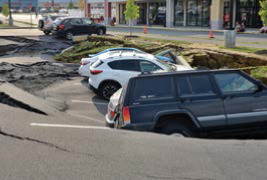
The Tanger Outlet Mall in Lancaster, Pennsylvania, U.S. summer of 2018, installed an HDPE underground detention system that quickly failed.
However, not all systems behave the same. Flexible systems are highly dependent on the soil envelope and installation techniques which can be an issue because installation sometimes can be very tricky if the contractor does not have enough experience to execute the installation for plastic materials. Precast retention systems are not very dependent on the soil envelope and, structurally, offer a great solution if the site has live and dead loads that must be addressed. The retention precast concrete systems are manufactured in a controlled environment, which can save time in the project’s procurement process since the manufacturer can control production, saving the owner time for the installation and, more importantly, money.
It is imperative to recognize the difference between each material and its behaviour. Selecting a product without knowing how the material will perform can be considered negligence and punished by the association or any competent jurisdiction that can prove negligence.
Purchasing a good watch can be expensive, but in the long run, a watch bought with meticulosity and patience will be more reliable than a watch that “will do the trick.” At some point, what costs less will be more expensive than the reliable watch that costs a little more.
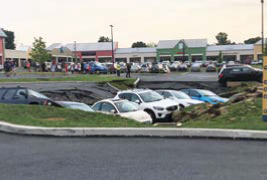
The Tanger Outlet Mall in Lancaster, Pennsylvania, U.S. summer of 2018, installed an HDPE underground detention system that quickly failed.
As the analogy of the watch, engineers and contractors have options to install something cheap from the get-go, but if the whole system collapses after the installation, what options do we have? Blame the product? Blame ourselves or blame the contractor? Ideally, no one, but that is part of the real world. The only solution is to select the suitable material from the beginning. Precast retention systems can be a powerful solution that can offer the capacity to withstand heavy loads upon the structure (live loads, dead loads, lateral forces etc.) inclusively; this material, due to its density, can be more reliable to buoyant forces than its counterpart, the flexible materials.
Protect yourself as an engineer and take care of that seal that was given to you. Do it right the first time; it can be less expensive.
Camilo Marquez, M.Eng., P. Eng.
Region Engineer MB – SK
Canadian Concrete Pipe & Precast Association

The iconic 405-acre Stanley Park borders downtown Vancouver, British Columbia, and sits pristinely on Burrard ...
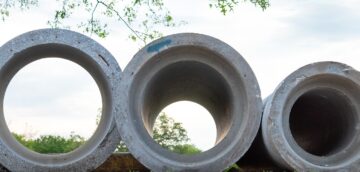
The following internal Ministry of Transportation of Ontario (MTO) memorandum dated June 2009 explains why ...
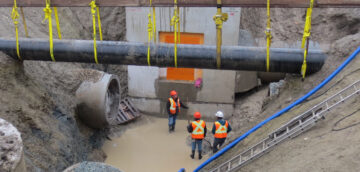
The project located in Calgary, Alberta, consisted of twinning the existing reinforced concrete pipe (RCP) ...
