
- Follow us


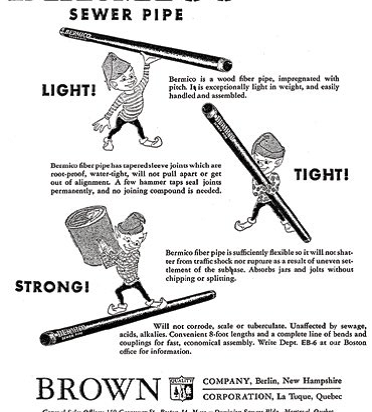
An article in the September 2010 issue of Environmental Science & Engineering Magazine (ES&E) by Dr. Mark Knight sheds some light on a pipe material called bituminous fibre pipe, commonly referred to as black fibre pipe. This pipe is no longer produced, however many municipalities in both Canada and the U.S. are currently dealing with unexpected failures of this product. The ES&E article gives a brief history of black fibre pipe:
“In the early 1990s, the City of Waterloo, Ontario, began experiencing premature failures of sewer laterals constructed of black fibre pipe (also known as Orangeburg or Bermico pipes) that had been in service for less than 20 years. Black fibre pipes, 51 to 200 mm (2 to 8 in.) in diameter, are compressed paper fibre tubes that are vacuum-impregnated with bituminous coal tar pitch to form a pipe composed of approximately 25% fibre stock and 75% bitumen.
RELATED: Concrete Pipe Greatly Reduces Excess Soil Challenges
During World War II, governments mandated limited domestic use of steel to aid the war effort. This, and the lower manufacturing cost of black fibre pipe compared to steel, clay and concrete pipes, led to the rapid usage of black fibre pipe for sanitary laterals, drains and conduits.”
A case study of the black fibre pipe situation at the City of Waterloo, Ontario or Ann Arbor, Michigan may be foreshadowing the future of many flexible pipe products being used today. The projected cost for the City of Waterloo alone was $26 million to replace black fibre pipe service laterals in 4,000 homes.
Causes of premature failure:
Possible causes for the failure of black fibre pipe include soil settlement, intrusion of tree roots, degradation of the pipe material, improper disposal of solvents by homeowners, and the extremely high temperatures of the water discharged by modern dishwashers and laundry machines. It is interesting to note that the manufacturers of black fibre pipe emphasized the need to properly bed the pipe with good compaction throughout the entire pipe zone. Today, a properly constructed soil embedment remains critical for flexible pipe. All pipe materials have strengths and weaknesses, however some plastics are more sensitive to extreme temperatures, may have a tendency to become brittle, and can degrade if exposed to hydrocarbons or common household cleaners.
Regulation does not guarantee good product:
The manufacturing process of black fibre pipe was regulated by ASTM D1861 and ASTM D1862 which included testing for resistance to flattening, crushing, strength, permeability, absorption and chemical resistance.
The State of Michigan Plumbing Code started to include various brands of black fibre pipe to its approved products list in 1949. The City of Ann Arbor was reluctant to approve this pipe material however it didn’t prohibit its usage since it was given State approval. After several failures, the city prohibited the use of black fibre pipe in 1970, while the state did not immediately follow suit.
Today, many municipal standards and the Ontario Building Code (OBC) clearly outline the pipe materials approved for a drainage system under its jurisdiction. For example, CSA B182.6 is included in the OBC list for HDPE pipe however specifiers should be aware that only certain HDPE brands are certified to this standard for 750mm diameter and smaller. HDPE pipe produced in accordance with CSA B182.8, AASHTO 294 and ASTM F2306 do not meet the OBC.
Timeless marketing strategy:
Advertisements that appeared in Public Works Magazine in 1952 for Bermico Sewer Pipe touts how tough and resilient their pipe is, and how it “can be counted on for a lifetime of trouble-free service”.
Many plastic pipe ads today list the same benefits claimed by Bermico for being “Tight”, “Light”, and “Strong”. Most new engineers can be described as Neophiliacs, a personality type that easily gets bored with the old and has a need for constant novelty and change. Drainage products are no exception as we are bombarded by marketing campaigns for “new & improved” pipe products with the hopes that you’ve forgotten about the mediocre products they sold you just a few years ago.

The philosopher, George Santayana once said, “Those who cannot remember the past are condemned to repeat it.” The current situation with black fibre pipe serves as a reminder of the long-term risk and enormous costs that could result from using a cheaper pipe material with a limited performance history.

A new development in Barrhaven, Ontario (just south of Ottawa) needed a bridge structure to ...
We need concrete, and a lot of it, as housing is getting desperate. We need ...
Pipe used in sewer and culvert applications are categorized as either “rigid” such as clay ...
