
- Follow us


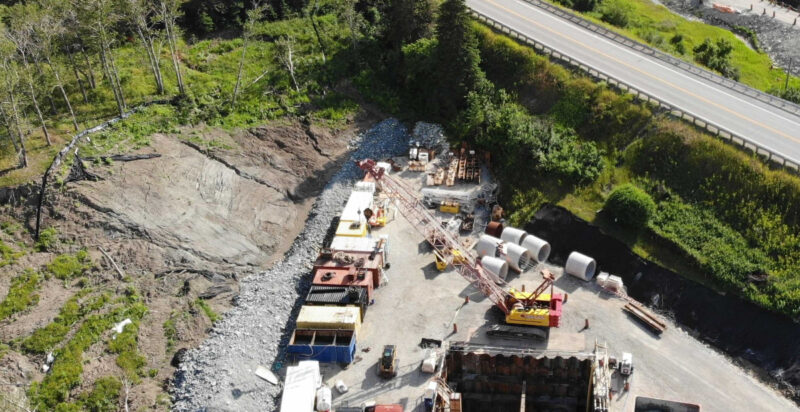
Harbourside Engineering Consultants (HEC) was retained by Construction Demathieu and Bard (CDB) to develop the structural design and temporary construction works required for the Calamity Creek Culvert Replacement Project, just north of New Liskeard, Ontario. The purpose of the project was to replace and decommission an existing cast-in-place reinforced concrete, single cell box culvert having a cross section of approximately 3.05m wide x 2.45m high, running 270m long. The existing structure was also situated up to 8m below the grade of the roadway, which added to the project’s challenges. Ministry of Transportation of Ontario (MTO) project specifications required twin 2.1m inside diameter (I.D.) pipe culverts to meet the predetermined hydraulic capacity requirements. The MTO contract also required that the project be completed without causing significant disruptions to the traffic along Highway 11.
RELATED: Precon Supplies Lined Vaults for Twin Sanitary Sewer Upgrade in Calgary
Forterra recommended that the concrete microtunneling pipe would be produced using the “drycast” process, which allows for higher production rates compared to the “wetcast” process. It was designed with a typical microtunneling joint consisting of a 13 mm thick galvanized steel ring. In addition to the steel end ring, the joint also featured a confined tapered profile gasket that provides a hydrostatic capacity of 30 psi. Forterra’s engineering team provided the structural designs for the pipe which were reviewed and accepted by Harbourside Engineering and the MTO.
The 2.1 m microtunneling pipe also needed to meet several quality assurance and certification standards, including the requirements of the Canadian Precast Concrete Quality Assurance (CPCQA) certification program. Pipe segments were also assessed using the requirements of the D-Load test and hydrostatic test, which were performed by Forterra at their manufacturing facility. The D-Load (or Three Edge Bearing test – 3EB) is a physical test used to ensure the pipe will provide the required structural capacity.

The tunneling contractor that was selected for this project was CRS Tunnelling. They selected an Earth Pressure Balance Tunnel Boring Machine (EPBTBM) for this project. The EPB allows soft, wet, or unstable ground to be tunneled safely with speed. This TBM was equipped with face control doors and chamber access in case the crew needed to go into the cutting head chamber for maintenance or inspection. The latter would prove important as the TBM did hit a major underground obstacle of wood debris during the first drive.
The twin pipe culverts were installed in two drives. Each drive would run the entire 270 m length. As mentioned above, the project did encounter a delay due to the debris, during the first drive but was able to finish. The delay resulted in the second drive occurring during a cold spell with some morning temperatures hitting -40°C. Both the concrete microtunneling pipe and the TBM continued to operate throughout this very cold temperature. The second drive broke through the receiving shaft on December 12, 2019. The project, which included the decommissioning of the existing culvert, was completed in October 2020.
Forterra’s concrete pipe/precast engineering expertise was a key part of this project’s success. Their contribution in terms of design and production of the microtunneling pipe solution along with their collaboration throughout the project exceeded expectations.
Greg MacDonald, P.Eng.
Senior Structural Engineer, Principal
Harbourside Engineering Consultants
Hamilton, Ontario
Precast Producer: Forterra Pipe & Precast, Ltd.
A corrugated steel culvert collapsed under the weight of a school bus in Rhome, Texas ...

As the City of Ottawa continues to expand, more challenges are encountered given that the ...
The South Branch of the Greater Sudbury Public Library closed abruptly on a Friday afternoon ...
