
- Follow us


A Critique of the Comparative Life Cycle Assessment of CSPI’s 1800 mm Corrugated Steel Pipes with North American Reinforced Concrete Pipes written by Groupe AGECO
The following document provides comments to help evaluate and clarify the findings of the November 2020 report prepared by Groupe AGECO on Comparative Life Cycle Assessment (LCA) of CSPI’s 1800 mm Corrugated Steel Pipes (CSP) with North American Reinforced Concrete Pipes (RCP). The comments are provided to help reviewers of the Groupe AGECO report understand the limitations and accuracy of the findings / claims of the report. The comments are broken down into the following sections:
Scope and LCA Functional Unit
LCA Scope – cradle-to-grave + Module D (benefits beyond end-of-life life) inclusion of Module D is key to the findings of the report. Module D takes into consideration recycling credits at end-of-life for both pipe types; however, it highly favours steel recycling which substitutes for primary steel production while the concrete pipe substitutes for aggregate – a downcycle activity. There is no data on how much of the CSP would be left for recycling after 75 years of service and if the CSP is even brought back to recycle facilities. The expense of transporting the deteriorated CSP from construction sites to a recycling facility probably costs more than the value of the scrap metal the contractor would get by recycling it. CCPPA has spoken with many contractors on this issue and have been told, that in their experience, the condition of CSP culverts do not present the likelihood that the material is viable for recycling.
LCA Functional unit – “provide a 11.8m long, 1,800mm diameter storm water drainage pipe for the N. American market in 2016 for 75 years”. Determining the functional unit is key as it represents “value choices” and possibly bias(es). Several questions arise from choosing this particular size:
Applicability of Study to Other Sizes of Pipes
The main limitation of this comparative analysis is that the results are only applicable to CSP and RCP products with a profile 1,800mm diameter and 11.8m in length for an equal service life of 75 years as manufactured in N. America (p. 27).
CSPI now has a link on its website for a carbon footprint Excel spreadsheet calculator, that can be downloaded to analyse different sizes of CSP versus RCP. Assuming this calculator is intended to allow a comparison of RCP and CSP for various pipe sizes, pipe thicknesses and lengths the information will be outside the bounds of the study. CSPI will have gone far beyond the key limitations of the AGECO LCA study as acknowledged by the study itself. Therefore, the results of the analysis of other sizes of pipes using the carbon calculator would not be valid and potentially grossly misrepresent the true LCA values.
We question the intention of this study and why were other types of pipes excluded from the analysis such as polyethylene (PE) and polypropylene (PP)?
Is it because a large CSPI member manufactures and sells these plastic pipe products? How objective is this study?
Life Cycle for RCP versus CSP
One of the main assumptions of the LCA study is that both the RCP and CSP products will last 75 years as required by provincial ministries on some projects such as storm water drainage for freeways as noted in the Ministry of Transportation of Ontario (MTO) document the study references. The study assumes both the RCP and CSP pipes will last for this 75 years design period.
Several documents noted below present evidence showing this 75-year life expectancy for CSP has not demonstrated this performance and is actually substantially less or not being allowed on some projects due to its expected life:
For Polymer Laminated (PL) & Aluminized Steel Pipe (AL T2) – coated pipes the document states, “The risk of premature pipe failure as a result of damage during the installation of a culvert in a rockfill embankment is significant for coated steel pipes. Damage to the coating will compromise its effectiveness; consequently, the estimated materials service life for the culverts cannot accurately be determined. Therefore, only concrete culverts are acceptable at these locations because of the nature of the risk, the probability of occurrence and most importantly, the consequences of premature failure.”
Why was HDPE, Aluminized Type 2 (ALT2) and Polymer Laminated (PL) not chosen for the above pipes? The document states, “These culverts are situated on the mainline of Highway 69 (future 400)/Highway 637 interchange ramps/Highway 637and are in areas of rockfill embankment where the depth from the top of the pavement to pipe invert is in excess of 3 m. Repair costs and mitigation measures as a result of premature failure due to improper installation, change in environmental condition or material defect are significant. Future replacement of these culverts would require full road closures or the construction of expensive detours. Full road closures on Highway 69 in this area would severely inconvenience and compromise the safety to the travelling public.”
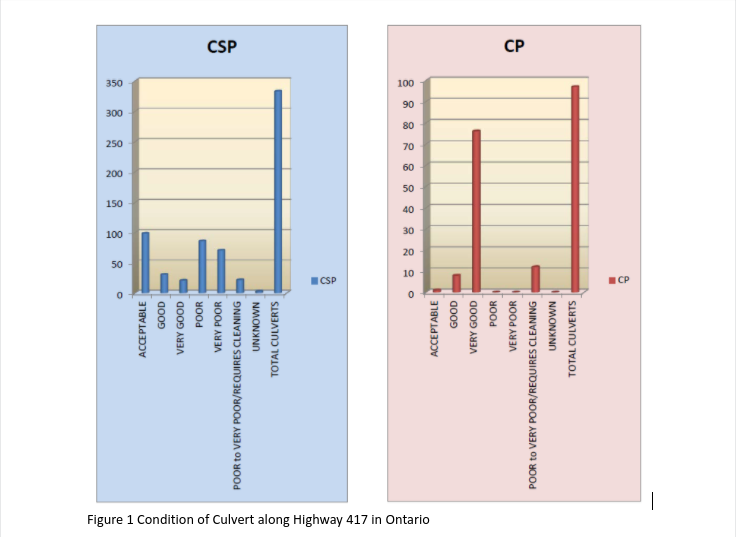
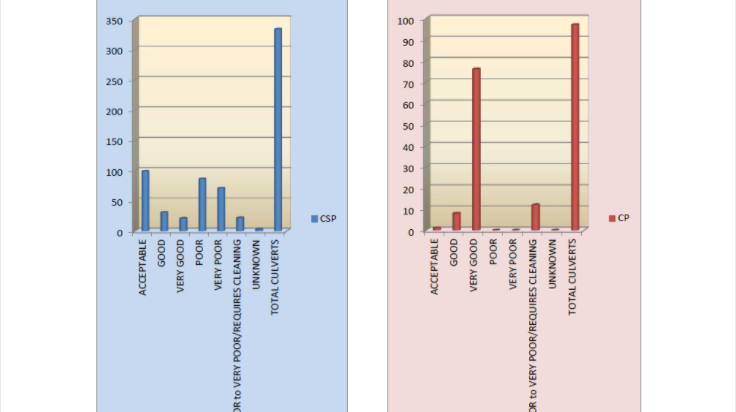
Based on this comprehensive condition rating study it is clear that RCP substantially outperforms CSP over time, again questioning the base assumption of the LCA study that the CSP and RCP both last 75 years.
Plastic Pipe Comparative LCA – Another recent pipe comparative assertions study completed by the Plastic Pipe Institute (https://plasticpipe.org/pdf/tr-53-2021.pdf) with a functional unit of 1,000 ft of 24” (600mm) stormwater pipe in use for 100-years and left in-place at end-of-life arrived at a GWP for CSP and RCP that was almost identical. This outcome underscores the degree to which the weight (or size) of the pipe, the supporting datasets as well as the LCA methodology choices can influence the overall result. It is noted that CSPI carbon footprint calculator reports a GWP comparative result for 600mm pipe favouring CSP by 50% over RCP. Therefore, the validity of the carbon footprint calculator is suspect and should be questioned based on the results of another independent LCA study.
Excess Soils: As of January 1st, 2021, the Ontario government has implemented an excess soils protocol for all construction projects. This legislation is designed to reduce the amount of excess soils generated from construction sites thereby reducing the green house gas emissions produced when excess soils are not utilised on site. Flexible piping systems such as corrugated steel pipe require an embedment envelope made from high quality aggregates and cannot utilise native soils. RCP can be installed with minimal high-quality aggregates while maximizing the use of native soils. The CSPI Life Cycle Assessment does not include the additional green house gases produced due to the higher amounts of excess soils that are generated when CSP is installed. Also omitted from this report is the significant increase in cost (in Ontario) for the testing, tracking, rehandling and possibly disposal as a waste of the excess soils generated when CSP is used versus RCP.
Hydraulic Design of RCP and CSP
The Manning’s “n” for concrete pipe is 0.012, regardless of diameter. The Manning’s “n” for 1800mm diameter corrugated steel pipe with a 125x 25 corrugation profile is 0.024. If the pipes are being used in a storm sewer application, or a culvert application which is in Inlet Control, the CSP diameter will need to be increased to 2,400mm diameter or larger, depending on the specific hydraulics conditions and design. The Manning’s “n” for CSP 1,950 mm in diameter and larger with a 125x 25 corrugation profile is 0.025. The increase is diameter of the CSP will increase the cost of the project and the carbon footprint. Competent design professionals will evaluate the difference in diameters between RCP and CSP due to hydraulic design. The Comparative Life Cycle Assessment study by Groupe AGECO does not mention increasing diameters of CSP due to hydraulic design. This is beneficial to corrugated steel pipe but is a major deficiency of this report.
Recycling of RCP versus CSP
The report states the recycling rate used for the scrap generated at the end-of-life of the CSP is ninety per cent. However, there is no data provided to support this very high percentage of CSP being left to be recycled after 75 years of service or if the CSP is even brought back from construction sites to recycle facilities. The majority of corrugated steel pipes is used in rural areas – typically two to five hour drives from major urban centres. The expense of transporting the deteriorated CSP from construction sites to a recycling facility may exceed the value of the scrap metal the contractor would receive by recycling it. The key assumption of 90 % recycling of the CSP may be grossly overstating the CSP LCA performance which has a dramatic affect on the results of the LCA CSP versus RCP analysis. This is beneficial to corrugated steel pipe but is another major flaw of this report.
When a Contractor replaces a CSP/SPCSP structure, the Contract typically states the material must be disposed of properly. This is accomplished in two ways, either recycled or placed in a landfill.
To recycle the CSP/SPCSP, the material must be reasonably clean. That means that there cannot be an excess of granular/silt/clay materials on or inside the culvert. If there is too much material on the steel, the recyclers will not accept it. They will also reject steel culverts that have excess corrosion or any corrosion perforations.
The recyclers will not accept any steel that has a coating on it. Galvanized, polymers, asphalt, etc. These coated steel culverts must be disposed of in landfills.
When a recycler does not accept the steel material, the landfill operators will look at it. If the material is uncoated, generally, it can be placed in a standard landfill. Coated steels, where the coating cannot be identified and verified as safe, need to be placed in a “lined” landfill at a considerably increased cost.
“We would excavate asphalt roads, concrete curb and gutter, concrete sidewalks, clay pipe, concrete pipe, and any old infrastructure made of brick and mortar and separate it from general dirt fill. This selected hard material was then stockpiled in our yard adjacent to the office. Once the pile was large enough a crushing Contractor was hired to come to the yard and process the material.
The crushing Contractor would feed the material into the initial crusher to break up the large pieces to separate any metal reinforcing steel embedded in the concrete. There was a magnetic separator conveyor that moved the steel out of the process and piled it next to the machine. The remaining material was conveyed to the primary crusher where it was crushed to the desired granular specification.
We crushed to a 3” minus specification so we could use the recycled concrete and asphalt as road bedding granular. The recycled material was “topped” with the specified “A” crushed limestone gravel, oiled, and paved according to the road design. Typically, the road subgrade material was specified as a thickness of “B” gravel. We would suggest “Value Engineering” where the recycled material was a design thickness more than the “B” gravel, but the overall price could be reduced due to the less expensive material.
We recycled a lot of concrete but very little RCP was excavated and replaced, and hence, was not recycled.”
Data Set Quality
The most important input HDG steel coil data reflects N. American production (considerably higher level of recycled content than world average – advantage CSP).
A similar North American dataset for rebar is/was available from the Steel Recycling Institute; however, the study relied on World Steel datasets for rebar embedded in the LCA software, which reflect considerably less recycled content than N. American rebar (as acknowledge in the report p. 28) – disadvantage RCP.
At the time of the report there were a considerable number of North American rebar EPDs available to pull on to support this project. The consultants reached out to the Steel Recycling Institute to gain access to the HDG LCI data, but did not request the rebar profile based on the same methodology – why was this done? This is beneficial to corrugated steel pipe but is another major flaw of this report.
A key driver in the environmental profile for any concrete product is its cement content. The CCPPA pipe EPD specified 110 kg of cement/metric ton of RCP while North American EPD for underground precast specified 135 kg of cement per m ton of precast – disadvantage RCP.
The cement datasets used also poses a quandary. Again, at the time of this study both CAC and PCA had appropriate EPDs available – as acknowledged in the report. In fact, they were available for the functional unit guiding year 2016. However, for reasons not explained, the report consultant decided to remodel both Canadian and US cement based on 2020 emissions data from Environment Canada and the USA EPA. Further, the combined North American modelling of cement weighted the US and Canadian cement profiles at 87% and 13%, respectively. As previously mentioned, the US electricity grid is dirtier than Canada’s and the GWP for US cement is also higher than Canadian cement – disadvantage RCP (the relevance of the US cement profile is questionable given CSPI comparisons are likely made in a Canadian context).
End-of-life benefits – 90% of the CSP is recycled and displaces primary steel production – this is a key scenario that influences the results – see below.
Reviews by independent infrastructure designers and project managers:
Craig A. Stevens, P.E., Bridge Design Engineer. DelDOT Transportation Solutions
“The main exception I took to the report was the difference in construction time it showed when comparing CSPs to RCPs. It is our experience at the ******* Department of Transportation that there is no time savings when placing CSPs as opposed to RCPs. When we schedule our projects, we would consider the timing for replacing RCPS and CSPs as the same. Intuitively, I believe that CSPs would take a little more time if the contractor were to follow the appropriate guidelines for the placement of CSPs such as the increased number of lifts and knifing in the bedding in the haunch.
Doug Kirk, P.E., C.F.M. – West Virginia Division of Highways
The old British phrase probably sums it up best: ‘Penny wise, pound foolish.’ And so ...
Peel Regional Council heard nine delegations on July 5, 2012 concerning the Hanlan Water Project. ...

Many underground infrastructure capital improvement projects are driven by capacity issues. The South Surrey Interceptorproject ...
