
- Follow us


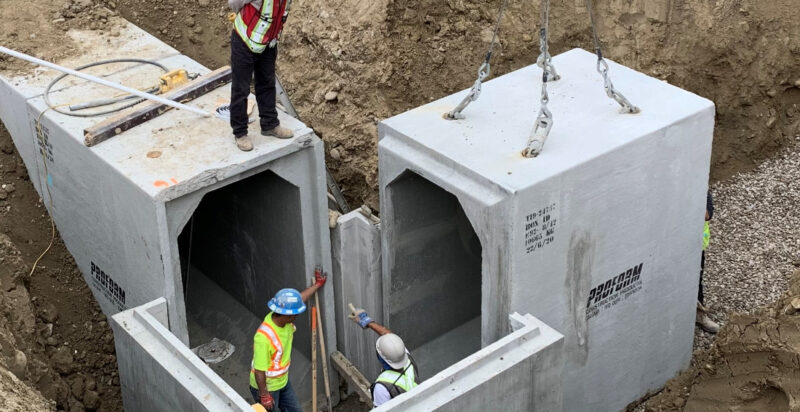
With communities seeing more and more surface flooding due to larger intensity storms and inadequate underground infrastructure, the City of Calgary is being proactive in mitigating flood waters in new upcoming communities. Anticipating flooding at the design stage not only adds future savings to homeowners but also has a big positive environmental impact on future communities.
Springbank Hill Phase 3 is one of these new communities to undergo large scale storm retention at the design and construction stage to mitigate future flooding and the need to upgrade existing underground infrastructure in the future, thus saving costs and negative environmental impact.
RELATED: Stanley Park Beaver Lake: Custom Box Culverts with Fish Ladders to Improve Ecosystem
In order to maintain the community layout and clearances to sanitary and other services, the storm sewer lines were placed in the middle of a winding road. This resulted in the requirement of having a 1200mm x 2400 mm precast concrete box storm water retention line to follow the “S” curve shape of the road.
In conjunction with Blue-Con (the general contractor), Proform’s engineering team produced a 3D model showing the location of each of the 100 precast box units that would be providing the stormwater retention system. In addition, this model was used to determine the location of each of the maintenance holes, ensuring that they would not be located between two ends of a box unit and providing the most effective use of each precast box unit. There were also a number of beveled, reinforced concrete pipes (1050 mm inside diameter) included in this storm sewer system.
Logistical coordination was also enhanced by the 3D model. The large majority of the box units were beveled to produce the required curvature and ensure that they would follow the roadway centerline. The 3D model was used to colour-code each of the boxes belonging to their appropriate radius and confirm that the proper beveled box was installed in the proper location and radius.
Given the high production demands, Proform was able to produce these box structures using the “dry cast” method which allows for higher production than the wet cast.
Approximately four to six boxes were produced per day. Using the modeling, Urban Systems, Blue-Con and Proform were able to coordinate production and ensure that the required boxes were produced and delivered to the site without causing unnecessary delays. This was key to ensuring that the project remained on schedule and in line with the design requirements.
I would like to thank both Blue-Con and Proform for their contribution to the success of this project, and highlight that a significant amount of effort was put into the design stage of this project with Urban Systems, Blue-Con and Proform working together. Through this early collaboration, we were able to identify and address a number of issues prior to the installation phase of the project to make this a successful project for generations to come.
Brock Dyck, P.Eng.
Project Engineer
Urban Systems Ltd.
General Contractor: Blue-Con
Precast Producer: Proform
Harbourside Engineering Consultants (HEC) was retained by Construction Demathieu and Bard (CDB) to develop the ...

A Critique of the Comparative Life Cycle Assessment of CSPI’s 1800 mm Corrugated Steel Pipes ...

The original Boulevard Lake Dam in Thunder Bay, Ontario, was built in 1901-1902 and the ...
