
- Follow us


Quick answer: “TULLOCH understood the need to collaborate early,” says Dan Haggerty of DECAST.
“TULLOCH understood the need to collaborate early,” says Dan Haggerty of DECAST.
“I received the initial call from John McDonald. He knew that consulting with those who would build and install the components would make the design and project planning processes efficient. And it ensured his design would consider all the challenges associated with this complex project.”
So began the Fort Creek Aqueduct Replacement project in Sault Ste Marie. With tight collaboration as the foundation for a complex, time-sensitive project in a busy commercial corridor.
Sault Ste. Marie’s Fort Creek watershed has a total catchment area of 1,516 hectares. It runs approximately 8 km to its outlet south of Bay Street West. A flood control dam intercepts run-off from the watershed; and the aqueduct channels it through a heavily urbanized area, known as Steelton, south to St. Mary’s River.
TULLOCH Engineering Inc. had completed a Class Environmental Assessment for the City of Sault Ste. Marie, to determine the hydraulic capacity required of a replacement aqueduct to meet current stormwater standards. Its hydrologic analysis of the watershed determined that the aqueduct must be designed to accommodate the highest flows generated by the Timmins Regional Storm.
RELATED: Precast Concrete Box Culverts Used for Stormwater Detention in Maple Ridge, B.C.
Parts of the original structure—a cast-in-place concrete box storm sewer—were over one hundred years old and required replacement to ensure the safety of motorists and pedestrians. The City engaged TULLOCH again to undertake detailed design and tendering for construction.
The project divided naturally into two phases based on scope and challenges. Phase 1 replaced a significant length of aqueduct under Wellington Street West, one of the main roads bringing traffic into the city. Phase 2 solved the specific challenge of replacing an aged box culvert running beneath a narrow laneway road with several utilities overhead.
Safety, time and space were key considerations for both phases. Phase 1 had to be implemented with two of Wellington Street’s four lanes always open for traffic. And sanitary laterals beneath the existing aqueduct had to be replaced without interrupting sanitary and water services. The key project challenges suggested that a precast solution would be the best option. The tendering process created a credentialed team to execute it, bringing together TULLOCH, DECAST Ltd., and Avery Construction Ltd.
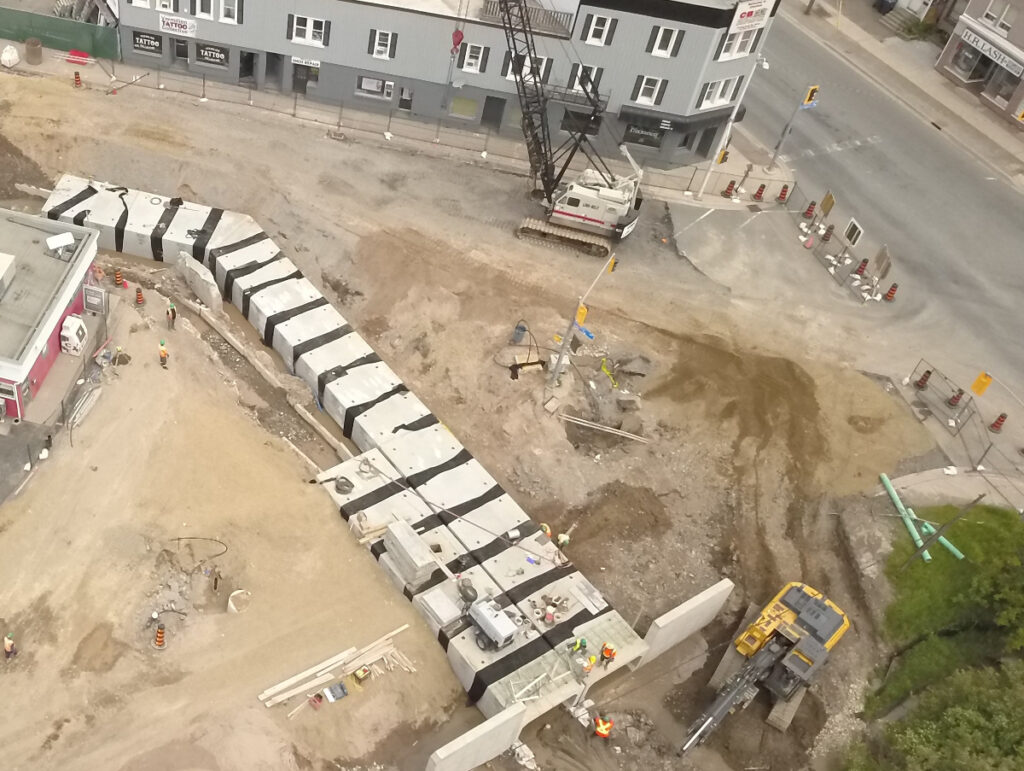
The team designed standard, 2.44-metre-long precast box sections to be installed beside the existing aqueduct. At various points along Wellington Street, sections were tailored: some included lateral pipe connections to carry water from the old to the new aqueduct, thereby allowing the old structure to be abandoned in phases; they switched flow between barrels of the twin cell closed box section; and, where possible, sections were made wider to maximize the size of the opening. These meticulous design details optimized the hydraulic performance of the aqueduct. They required TULLOCH to collaborate continually during the design process; from DECAST’s constructability assessments and tight dimensional tolerances for precasting, to the exacting installation by Avery Construction. The benefits to Sault Ste. Marie were clear at the end of Phase 1: a critical infrastructure project completed safely, with minimal impact to traffic and significant budgetary savings.
Phase 2 presented still more complexity. But again, the TULLOCH-DECAST-Avery collaboration found smart solutions. TULLOCH’s John McDonald described the challenge:
“Part of the existing aqueduct was a cast-in-place box culvert from the early 1900s. Its lid formed the road surface for a laneway parallel to John Street. It had failed a few times and become a burden on city maintenance and a public safety hazard.”
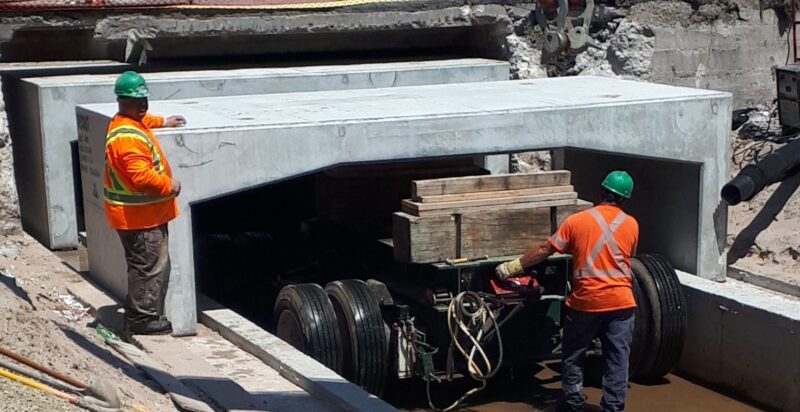
Property limits in the laneway approached the edge of the old aqueduct, so the team had little space to work in. A web of overhead utilities and an irregular shape through the cross-section compounded the challenge. The team looked at liner options during TULLOCH’s design but the shape, hydraulic and structural concerns demanded a robust structural solution with sufficient hydraulic capacity. TULLOCH and DECAST devised a three-sided, precast culvert that would sit on new footings within the existing structure. While avoiding demolition and removal of the old culvert, the solution left a restrictive area that would determine the size of new precast items. The structural design called for 45 MPa concrete to achieve thinner precast walls and an interior shape to accommodate maximum stormwater volumes. Each section would then slide into place with only 50mm of buffer space at its sides and 25mm above. Avery Construction’s custom hydraulic cart answered the challenge of lifting the precast sections 25mm above the foundation’s keyway, moving the sections along the aqueduct line, and then lowering them into place.
The team designed and constructed 95% of the Phase 2 structure this way. The remainder, where the aqueduct crossed John Street, benefited from extra space. It allowed a full demolition of the existing structure. The replacement precast sections here tied into a secondary bypass aqueduct, twinning the overflow structures in the middle of street.
Precast was undoubtedly the right choice for this project. But its design was just one of several collaborative initiatives that combined to deliver an exceptional piece of infrastructure for the City of Sault Ste. Marie. Open communication in design, manufacture and installation were crucial. The team shared its expertise freely. And all partners clearly took a conscientious approach to service, contributing to early completion within agreed budgets.
Russell Sleaper, Project Coordinator, Tulloch
Harbourside Engineering Consultants (HEC) was retained by Construction Demathieu and Bard (CDB) to develop the ...
No one likes a drippy faucet at home, so why should a drippy pipe underground ...
The South Branch of the Greater Sudbury Public Library closed abruptly on a Friday afternoon ...
