
- Follow us


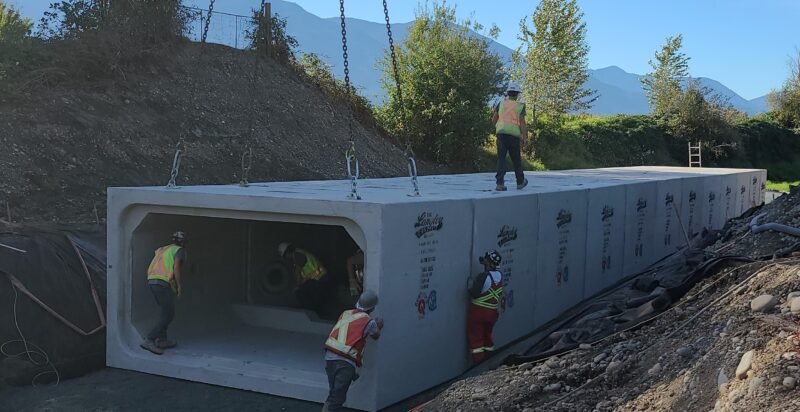
In 2020, the District of Kent in Agassiz, B.C. engaged Urban Systems to design the replacement of the Agassiz Flood Gate. Agassiz is a small-town NW of Chilliwack and about a 90-minute drive from Vancouver. The flood gate is located on Dyke Road west of Highway 9 (Agassiz-Rosedale Highway) and south of Whelpton Road. Adjacent to Dyke Road on the north end (upstream) of the existing drainage culvert, is the Agassiz slough. This slough sees most of the storm water runoff from the Town of Agassiz, B.C..
The existing culvert was a 1.5 m diameter corrugated steel pipe with a top-mounted flap gate. This structure was roughly 50 years old and provided flood drainage away from the Town of Agassiz, B.C. by transporting slough water through Dyke Road. There were several issues with the existing structure that made it less than ideal and a risk to the community. The 1.5 m diameter CSP was significantly undersized for a 1/100-year flood event. The age of the structure made it a high-risk of failure, and the original structure design, with a top-mounted flap gate, did not permit adequate fish passage. Replacement of the structure was well justified.
RELATED: Customization provides wildlife crossing box culvert
The Urban Systems Engineering Team explored the various options for this site and ultimately chose to use a precast concrete box structure. This choice provided the best option for mounting the heavy and large steel slide flood gate. The precast concrete option was also a good choice for incorporating integrated fish baffles and providing a design life of over 100 years in a constantly submerged condition. At this point, the Langley Concrete Group was contacted to lend their expertise in precast concrete design and manufacturing.
A 3.66 m wide by 1.83 m tall precast concrete box was determined to provide a hydraulic design flow capable of withstanding a 1/100 year flood event. 300 mm tall by 254 mm long fish baffles were cast integral to the precast concrete box for the entire with of the opening. One baffle was required at each of the precast sections on the downstream side with the first upstream box section requiring one at both the upstream and downstream ends. The upstream and downstream aprons were also precast concrete and required the installation of timber piles below. These piles would counteract the potential settlement of the aprons and ensure proper vertical alignment with the channel for the duration of structures life. There were 4 piles for each apron. The upstream end features a full width and height trash grate. The downstream end has a full width and height vertical slide gate. The gate is mounted directly to the precast concrete by a stainless steel wall thimble frame embedded into the downstream precast section.
Langley Concrete Group completed the structural design of the precast concrete box complete with the design for the integrated fish baffles, trash grate, and vertical gate attachment. In addition to this, there was a significant amount of engineering required for the precast end treatments consisting of head-walls, wing-walls, and aprons. The size of the end treatments was challenging for manufacturing, transport, and installation. The final design utilized modular section, for ease of transport, with in-cast weld plates, for onsite assembly.
After the project was tendered, the precast concrete sections were manufactured. All the precast was complete before the contractor began work on site. The precast structure not only provided the contractor with the potential for an accelerated construction schedule, but also mitigated the risk of delays due to manufacturing, weather, and/or labour shortages. The Langley Concrete Group assisted the contractor with the delivery details as well as the crane placement. The site logistics were challenging due to the small footprint available for construction. The project was successfully completed in 2021. Urban Systems and The District of Kent would like to thank Langley Concrete Group for their innovative solutions for the many challenges associated with this project.
In November 2021, the lower mainland of British Columbia experienced a significant weather event. This event was labeled as an “Atmospheric River” and brought heavy rain fall to the area of southwestern British Columbia and northwestern Washington State. The result of this storm event was the declaration of a state of emergency for the area, flooding in select areas within the region, significant transportation disruption, and the loss of a considerable amount of transportation and drainage infrastructure. It has been estimated that the event was between a 1/200-to-1/500-year event.
The District of Kent has stated that the Agassiz Flood Box handled the flows adequately with water levels reaching within a few inches of the top of the concrete box structure. The flood waters did not overtop or surcharge the structure. Without this structure, it was likely that the Town of Agassiz, B.C. would have seen widespread flooding.
The town is fortunate that the new structure was installed and completed when it was.
Joel Thomson, P.Eng.
Communities Engineer
Urban Systems
Precast Producer: Langley Concrete Group

What is self-compacting bedding?Self-compacting bedding (SCB) materials, also known as self compacting soil, self-consolidating soil, ...
Peel Regional Council heard nine delegations on July 5, 2012 concerning the Hanlan Water Project. ...
In HBO’s new hit series, The Last of Us, you probably noticed a key part ...
