
- Follow us


No one likes a drippy faucet at home, so why should a drippy pipe underground be any different? Municipalities in Ontario are paying far greater attention to the state of their sewers. The cliché, “out of sight, out of mind” is not an accepted practice anymore.
There are several reasons why a sewer pipe with a leak is not desirable.
PURPOSE: The obvious…it’s not what the owner paid for. A leak in a sewer pipe is an opportunity for groundwater to infiltrate into the sewer system, or, for sewer flow to exfiltrate from the pipe into the ground. A quality pipe with watertight joints will provide the desired performance. Reinforced concrete pipe (RCP) provides watertight performance by using rubber gaskets in its joints.

Concrete pipe joint with rubber gasket
COST: Leaky sewers cost money. Extraneous flows that infiltrate into a sanitary sewer system translate into unbudgeted costs to treat additional sewage volumes at the wastewater treatment plant. The unexpected flows also take away from needed sewer capacities designed for future municipal growth. York Region is currently revamping its guideline for the commissioning of new sanitary sewers. It will implement best practices with the goal to reduce infiltration, one of two contributors to a sewer system wide problem called Inflow & Infiltration (I/I).
RELATED: Concrete Pipe Replaces Two Year Old Storm Sewer
HEALTH: A very real concern is the possibility of a leak from a sanitary pipe into local groundwater used for drinking purposes. Municipalities in Ontario have been exercising best practices for years by citing MOE’s Design Guidelines for Sewage Works. For inhabited areas that rely heavily on groundwater for drinking water sources, one cannot afford the risk of contaminating subsurface drinking water reservoirs and groundwater well sources.
STRUCTURAL: Where there is movement of groundwater and voids present within a pipe’s supporting soil, a loss of pipe support can occur. It is the result of fines that can migrate to and from the embedment zone around the pipe. This is very probable if clear stone is used to support or backfill the pipe. Another opportunity for the migration of fines is infiltration through a leaky pipe. Either way, a loss of support will lead to severe pipe distortion and/or structural failure of the pipe. Similarly, the article in this edition regarding the Sudbury library looked at the effects of a corroded CSP sewer whose leaky joints assisted in the migration of fines in the proximity of the building’s foundation.
For the reasons stated, it is unclear why a lower standard of joint performance or lack of a certification program for pipe would ever be used. If the intent is to have infiltration, then use products that are specifically designed to infiltrate groundwater at controlled rates.
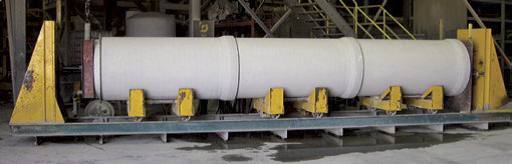
The hydrostatic performance of RCP is verified by tests done at the manufacturing plant according to the Plant Prequalification Program (PPP). The PPP ensures RCP will meet the hydrostatic requirements specified in CSA A257.2 for concrete pipe with rubber gasket joints. Certification under the PPP then provides the engineer the assurance that a watertight and certified concrete pipe product is on site.
The PPP was first established in 1965 by Ontario Water Resources Commission (OWRC) and OCPA, and has evolved with different regulating bodies, including the Ministry of Environment, and the Ontario Clean Water Agency. Today, the PPP utilizes an Advisory Committee represented by: Municipal Engineers Association (MEA), Ministry of Transportation (MTO), Ontario Provincial Standards (OPS), Concrete Precasters Association of Ontario (CPA), and the OCPA. The Advisory Committee is responsible for administering the PPP and in turn used to prequalify plants, manufacturers and products of the precast concrete drainage products industry.

Hydrostatic test of concrete pipe
Hydrostatic testing of concrete pipe under the PPP includes the following parts:
Further details of the hydrostatic test or the PPP can be accessed via the “Technical Resource Centre” link found on OCPA’s website, www.ocpa.com.
Does all this guarantee zero leaks in a pipe sewer? Not quite. One must compliment pipe quality with a good installation. A quality installation of pipe will provide the necessary support for the pipe and help assist the joint to perform as expected (i.e. to be watertight). A quality installation includes a prepared base, compacted granular material that uniformly beds (supports) the pipe, and a permitted backfill material that is compacted around the remaining pipe. It also includes the proper placement and seating of the rubber gasket on a clean, undamaged joint. Lastly, an adequate amount of time allocated to field inspection will help ensure the pipe installation is done correctly. Together, product quality and installation quality will improve pipe performance, and help mitigate the occurrences of leaks sometimes seen in new sewer construction.
NO PLUMBER REQUIRED HERE!
The following internal Ministry of Transportation of Ontario (MTO) memorandum dated June 2009 explains why ...

The City of Sarnia, Ontario is experiencing significant growth and like many other municipalities acrossCanada, ...

As part of our vision on education, the Canadian Concrete Pipe and Precast Association is ...
