
- Follow us


Besides “manholes” being renamed “maintenance holes” in the mid 1990’s, the standards for precast concrete MH’s in Ontario have not needed to change significantly…until now.
Maintenance holes (MH’s) have been a critical part of sanitary sewer systems for hundreds of years. In addition to providing access to buried pipe for inspection and maintenance, design engineers use MH’s for elevation and direction changes in the sewer system. Like sewer pipe, MH’s are required to resist the live loads from traffic, hydrostatic head pressure from groundwater, stresses from freeze-thaw cycles, forces from soil settlement, and corrosion from sewer gas and de-icing salts. Experienced municipal engineers understand that a poorly designed, or constructed, MH can contribute to the rapid deterioration of the entire sewer system.
RELATED: Leaky Sewer Pipe: Should Someone Call a Plumber?
Precast concrete replaced the brick and mortar MH’s over 40 years ago resulting in consistently high quality structures, while drastically reducing the time and cost to construct them. The purpose of benching a MH is to allow the effluent in the sewer system to flow through the structure undisturbed, as if it never left the pipe. If done poorly, it can lead to performance issues such as abrasion and turbulence causing the release of sewer gases. Today, the benching in the base of the MH is typically created by hand forming the channel with ready-mix concrete in the field, as shown in Figure 1. This results in a disparity in quality and workmanship due to the different skill levels and adverse work conditions. Because infrastructure funding is spread so thin, municipalities are taking a business-like approach to sewer maintenance through risk assessment and asset management which makes it clear that the life-cycle cost and solutions to maximize the service life of new infrastructure are imperative.
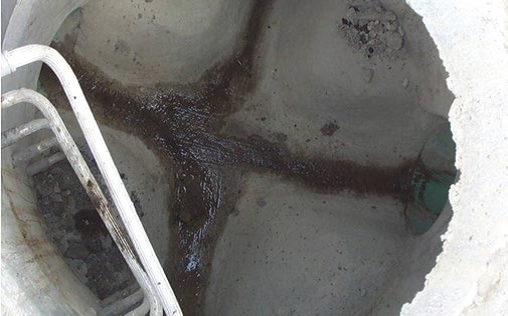
Figure 1 – Typical Field Benching

Figure 2 – High Quality Precast Benching
The use of a precast concrete MH with factory-made benching has been gaining in popularity and offers many benefits; however, due to the infinite combinations of pipe size, pipe angle, and invert drop, even precast benching becomes a made-to-order, labour-intensive operation for the MH producer using channel form kits and a secondary concrete pour. Also due to the variations in the municipal benching design standards across Ontario, the potential to reduce lead-time and minimize the cost of MH construction with standardized precast concrete benching is not yet being realized.
The producer members of the OCPA recognize that there is an opportunity to benefit all stakeholders if they are able to keep inventories of uniform, mass produced MH bases with standard precast benching patterns. The industry has developed the 10 standard patterns shown in Figure 3, with fixed inlet to outlet elevation drops based on calculated energy losses by consulting firm MTE Consultants, and made the decision to initially offer only obvert benching based on hydraulic research conducted by Jiri Marsalek at the National Water Research Institute. The industry proposal is also limited to 200 and 250mm uniform channel sizes for now, which is applicable to the majority of new sanitary sewer construction projects.

Figure 3 – Proposed 10 Standard Benching Patterns
The potential benefits of standardized prebenched MH bases include:

Figure 4 – Factory Produced Benching
Summary:
There are many benefits from standardizing the design of MH benching. A consensus on standard MH benching geometries by Ontario Provincial Standards and the Municipalities would compel the design engineers of sewer systems to incorporate the 10 standard benching patterns proposed by the OCPA members, similar to the standard fittings currently used in watermain design.
The OCPA producer members have spent many years to study and establish an acceptable industry-wide design standard for 1200mm diameter MH benching configurations and energy drop heights between inlet and outlet pipe. Some municipalities such as the Town of Markham have already recognized that benching to obvert provides a higher level of service performance and have adopted design standards that go beyond the current OPSD 701.021 by requiring obvert benching only.
Once MH producers start to keep an inventory of these parts, there could be less than 1-day lead times for sewer contractors to take delivery of prebenched MH bases. The need for accurate placement of these MH bases may cause some resistance from sewer contractors however the adaptable contractors in Ontario have proven to be very innovative, so this should be no exception.
Please contact the OCPA at resources@ocpa.com if you are interested in a presentation on this product line.
When specifying pipe material for pipelines and culverts, the design engineer, contractor, and eventual owner ...

Sewer pipes not only function as a conduit to transport stormwater or wastewater, but they ...

Sewer pipes not only function as a conduit to transport stormwater or wastewater, but they ...
