
- Follow us


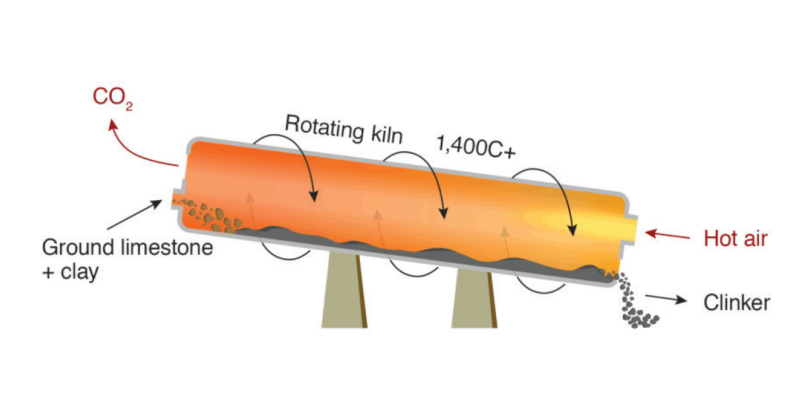
Where to begin? Let us start with where all the carbon in concrete comes from. It comes almost entirely from the production of clinker, the precursor to cement. Without getting too much into chemistry, to make clinker, you use fossil fuel-fired heat to split off the CO2 molecule from calcium carbonate (“calcining”), from which the remaining calcium oxide reacts with other minerals to form clinker. There are two sources of CO 2: calcination (two-thirds) and the use of fossil fuels to provide energy (one-third). This adds up to anywhere from 600 kg of CO 2 in every tonne of cement to 850 kg, depending on the plant. If you add carbon emissions from electricity, mobile equipment,delivery trucks, and other fuel use, you get close to the famous rule of thumb of one tonne of carbon emissions for every tonne of cement. The good news is that the industry is already moving towards net zero and has published a net zero strategy report on May 2nd, 2023. Here is a summary of the “Five Cs” strategy below:
The First C of Decarbonization is Clinker
We can use lower-carbon fuels to replace fossil fuels; we can be more energy efficient in the production of that clinker; we can use renewable electricity, and we can look for sources of calcium that do not calcine. The Canadian cement industry is already underway with these actions. Long-term research is underway to find new ways to produce clinker. As an aside, taking waste out of landfills and processing it into lower-carbon fuels has the side benefit of preventing landfill carbon emissions.
The Second C of Decarbonization is Cement
Cement, at its simplest, comes from adding gypsum and limestone to clinker and grinding it into a fine
powder. We learned that if we grind finer, we could add up to 10% more limestone (i.e. less clinker in the mix) and produce the CSA-approved type GUL cement. Within the next few years, the production of Ordinary Portland Cement (GU) will cease as the industry responds to carbon pricing pressures. Delivery of cement to ready-mix and concrete product plants is a final component of this strategy, as is using data to improve logistics and eventually adopting newer transportation methods when they become available.
The Third C of Decarbonization is Concrete
We can use statistical controls to provide precisely the right amount of cement needed for the job, not a kilogram more. We can apply digital solutions to optimize product deliveries, including measures to reduce returned concrete. The innovative use of admixtures will certainly emerge as a solution here too. However, moving from recipe standards to performance standards will be the most significant gain. I liken today’s specification approach to someone walking into an artisan bakery, asking for a chocolate cake, and handing the chef a recipe. Recipe specifications stifle innovation. This C also plays an important role in the well-established use of supplementary cementitious materials, such as slag, fly ash and many others. These strategies effectively reduce the amount of carbon-intensive clinker in concrete mixes while delivering a quality product.
The Fourth C is Construction
This is emerging as one of the more exciting decarbonization strategies. Architects, engineers, and designers have so many levers under their control to reduce the amount of clinker, and therefore carbon, ultimately in their buildings. This could take the form of putting exactly the right amount of concrete strength where it is needed using computational structural design. It will require a new level of communication across multiple layers of the supply chain, from the cement maker to the architect. What will drive this is demand for net zero buildings and clean procurement, accompanied by strong governance to ensure authentic low-carbon products surface out of a greenwashed product sea.
The Fifth C is Carbonation and Carbon Capture Utilization and Storage (CCUS)
This is a fascinating time in the cement and concrete industries. An interesting and unexploited capability of concrete is the carbonation of CO 2 . We estimate that 20% of the CO 2 released in making cement turns back into limestone over a building’s lifetime. Notably, this is the opposite of the calcination reaction when making clinker. Many Canadian start-ups are exploring the mineralization of CO 2 into stone, sand and gravel products. Perhaps someday, concrete companies will mix negative carbon aggregates into their concrete, offsetting all the CO2 emitted at the cement plant to deliver a zero concrete product. We are not there yet, but keep an eye on this space. Capturing CO 2 for use in products or for geological storage is an active area of research, with the first cement plant CCS projects already in the pipeline. Decarbonization pressures will drive innovation and renewal in the cement and concrete sector, and we’re just getting started. Necessity is the mother of invention, after all.
Robert Cumming MASc, P.Eng.
Head, Sustainability & Public Affairs,
Eastern Canada
Precast Producer: Lafarge Canada Inc.

As the City of Ottawa continues to expand, more challenges are encountered given that the ...
In 2020, the District of Kent in Agassiz, B.C. engaged Urban Systems to design the ...
With communities seeing more and more surface flooding due to larger intensity storms and inadequate ...
