
- Follow us


The City of Sarnia, Ontario is experiencing significant growth and like many other municipalities across
Canada, Sarnia must upgrade segments of its infrastructure to meet this increase as well as the anticipated future growth.
One infrastructure project that was top of the list for the City of Sarnia was the Bedford Pumping Station Replacement that was rolled out in three phases:
Phase 1 – Trunk Sanitary Sewer and Forcemain
Phase 2 – Indian Road Pumping Station
Phase 3 – Trunk Sanitary Sewer Microtunneling
Construction commenced in 2019.
Phase 3 of the project was specified as a microtunneling installation for the sanitary trunk sewer. The microtunneling option was chosen due to the following challenges and advantages:
Phase 3 would require 1791 m of 1350 mm diameter microtunneling pipe. The external dimension of the pipe is 1689 mm in diameter.
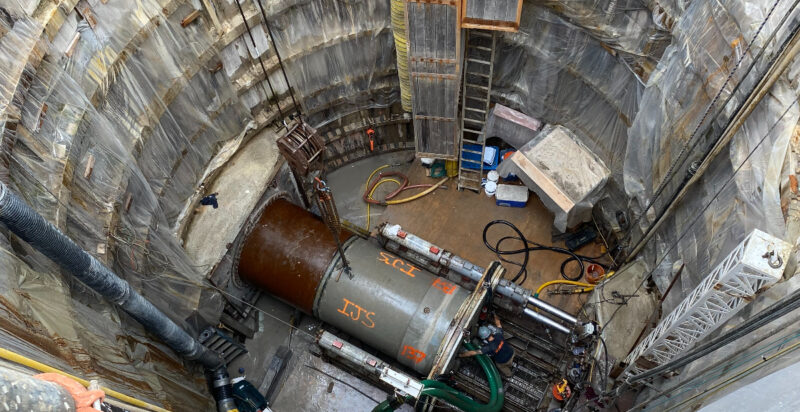
A total of three drives would be required with three shafts sized at 9 m in diameter and one shaft, one sized at 6.5 m in diameter. The shaft at the pumping station will be equipped with a vortex separator for odour control.
Drive 1:
• Shaft 3 (Launch – 6.5 m) to Shaft 4 (Receiving – 9 m)
• Length 498 m
Drive 2:
• Shaft 2 (Launch – 9 m) to Shaft 1 (Receiving – 9 m)
• Length – 675m – under CN rail yard
Drive 3:
• Shaft 2 (Launch – 9 m) to Shaft 3 (Receiving – 6.5 m)
• Length – 618 m
In conjunction with CRS Tunnelling, the microtunneling contractor awarded the project, Forterra organized a plant tour for the City of Sarnia’s engineering staff as well as AECOM the consulting engineering firm overseeing the project.
RELATED: 100-Year-Old Thunder Bay Dam Refurbished with Precast Elements
This allowed for the City of Sarnia staff to better understand the various aspects of the microtunneling pipe product being produced as well as the manufacturing and engineering
expertise that Forterra provided to the project.
Forterra prepared the required pipe design for the microtunneling pipe. As with standard reinforced concrete pipe, these structural elements are required to meet the dead and live loading that will be applied to them during their service life. In addition, a microtunneling pipe is required to meet very high axial loading due to the microtunneling installation process. This is typically the governing factor in the pipe’s design.
Forterra was also able to mobilize specialized 1350mm MT formwork, from their Ohio operation, to allow for local manufacturing to take place out of their Cambridge production facility.
For this project, Forterra produced 732 pieces (2.4 m long) of 1350 mm inside diameter, 140-D microtunneling pipe. Grout ports are required to be cast into each pipe section in order to provide lubrication as the pipe sections are jacked into place behind the microtunneling machine. CRS requested that every 60m should include a length of pipe with 5 grout ports. Of the 732 pieces produced, 30 were produced with 5 grout ports and the remainder produced with 1 grout port.
From the start of this project, the Covid-19 pandemic delayed the construction schedule. Setbacks were caused by individuals being quarantined as well as travel restrictions between the U.S. and Canada which delayed the arrival of members of CRS’s microtunneling team that are based in the U.S.
As part of the microtunneling process, CRS did utilize an Intermediate Jacking Station (IJS) for Drives #2 and #3. The IJS is used to ensure that the axial loads would not be exceeded given that both these drives exceeded 600 m in length. For Drive #1, the total length was only 498 m and axial loading would not be
an issue.
Although Shaft 2 and Shaft 3 were designed as temporary tunnel launch/reception shafts and Shaft 1 and Shaft 4 were to be cast-in-place, AECOM and the City of Sarnia approached Forterra to see if a precast maintenance hole structure could also be designed and fabricated for Shaft 2 and Shaft 3.
Cooperation on this project was key to its success. One example was CRS, Forterra and Hamilton-Kent (gasket manufacturer) were able to quickly address an issue with the seal between the trail pipe and the steel housing of one of the intermediate jacking stations. Hamilton-Kent was able to redesign the gasket, produce it out of their Toronto manufacturing facility and had it delivered to the job site within 12 hours.
For the City of Sarnia, this was the largest microtunneling project that has ever been undertaken. We would like to thank AECOM, CRS Tunnelling and Forterra for their contribution to the success of this project.
Bryan Prouse, P.Eng.
Manager, Operation Services
City of Sarnia
Precast Producer: Forterra Pipe & Precast

IntroductionPrecast concrete has been widely used in constructing infrastructure for decades. Its ability to accelerate ...
CBC Sudbury broadcast investigative reports by Megan Thomas and Markus Schwabe on deteriorated bridges and ...
Located in the West End of the National Capital Region (Ottawa), the North Kanata Trunk ...
